
Burton Directory Collection Runs
Burton research often starts in Flint-area volumes rather than in a separate city book. Gloria Coles Flint Public Library identifies R. L. Polk and Company directories for Flint and surrounding communities from the 1890s to the present, with annual and publisher gaps that must be checked in the actual run. The Library of Michigan also describes Polk coverage reaching suburban communities and notes Bresser as an important late-1960s publisher. A dated entry is evidence of what that particular issue printed, not proof that every Burton household was included.
| Collection | Years | Where Held | Access |
|---|---|---|---|
| Flint-area Polk and other city directories | 1890s to present described, with year gaps to verify | FPL and Library of Michigan | Library catalog, print, microfilm, or partner database |
| Street, phone, and classified arrangements | Publisher and edition dependent | Directory volumes and microfilm | Search by surname, street, phone, or classification where present |
| Flint city directories at NARA | 1929-1932 identified | National Archives finding aid | Federal digital and finding-aid route |
| Burton Township assessment rolls | 1856-1876; 1884, 1900, and 1920 | Archives of Michigan, RG 63-30 | Finding aid and request route |
| Burton Township poll books and electors | 1880-1898; 1859-1881 | Archives of Michigan, RG 63-30 | Finding aid and request route |
The useful shelf is broader than a single directory. FPL holds school yearbooks, local publications, organization histories, newspapers, and the Genesee County Biography File. Those materials can bracket a listing with a date, spelling variant, or local connection. Their coverage differs by title, so an absent name can reflect a missing edition, an incomplete area, a head-of-household-only format, or an indexing difference.
Note: Record the edition year and the printed geography before comparing a Flint listing with a Burton address.
Flint Shelves for Burton Records
The Gloria Coles Flint Public Library Local History & Genealogy room is the clearest local access point for Burton directory work. Its collection combines open-stack books, microfilm, county histories, cemetery readings, Ancestry access, scanning, printing, and a Genesee County and Flint collection. Posted room hours are Tuesday through Saturday, 11 a.m. to 5 p.m. The library also points house-history researchers toward directories, plat maps, county histories, Sanborn coverage, assessor and treasurer records, deeds, clippings, and the Historic Homes Binder.
FPL's local-history collection is shown here because the room brings directory volumes and companion research tools together.
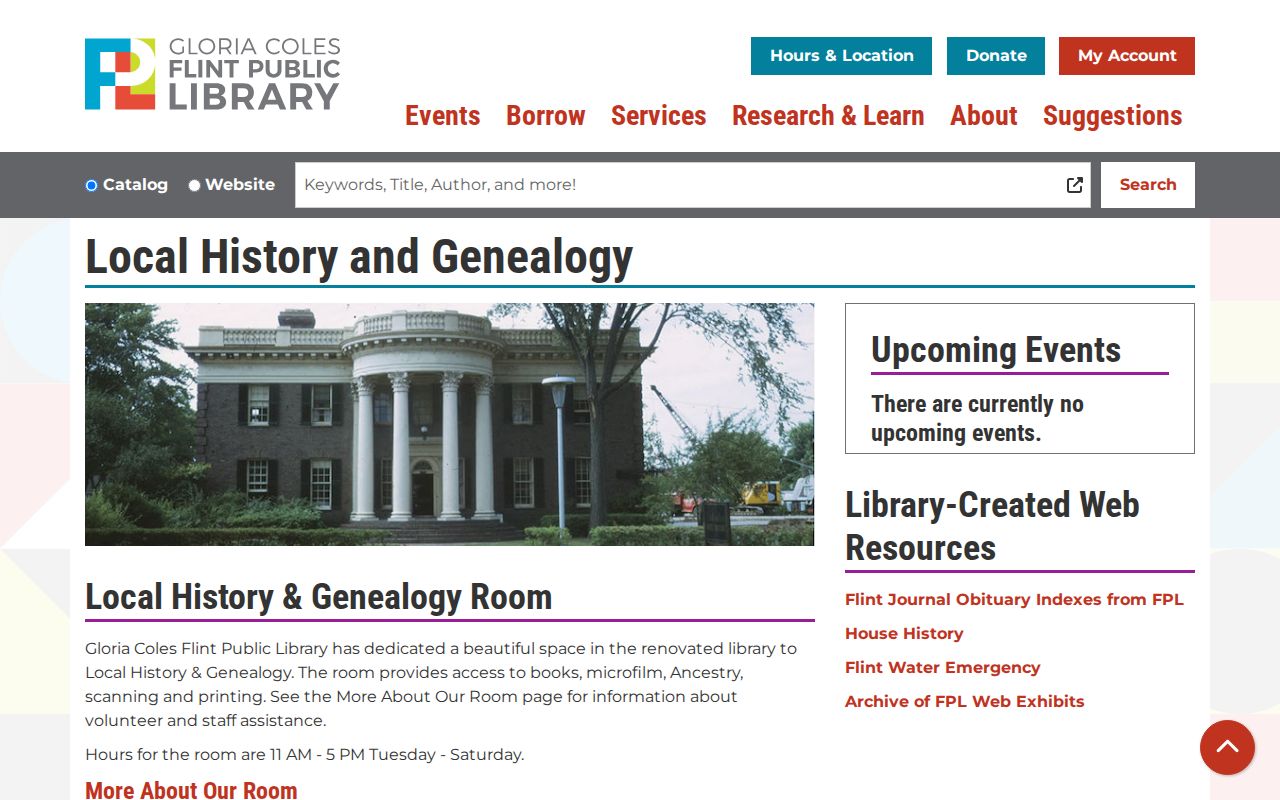
Use the catalog or staff help to identify a volume before relying on a date range. The room is a research channel, not a guarantee that every Burton address has a surviving entry.
How Burton Directory Entries Read
A city directory entry should be copied as a small dated record. Start with the title, publisher, city, edition year, and the page or image reference. Then preserve the surname, given name, relationship or honorific marker, address, and any business or organization label exactly as printed. The Library of Michigan says typical volumes may include other household members, an exact address, an occupation, an ownership or occupancy marker, and a business listing. Those fields vary by edition, so a field's absence is not a negative finding.
| Publication | Publisher, place, edition year, and catalog, call number, or database reference establish the time frame. |
|---|---|
| Name | Copy surname, given name, honorific, and any relationship or spouse marker exactly as printed. |
| Occupation or listing | Preserve an occupation, business, organization, or classified wording only when that edition prints it. |
| Address | Copy the exact street address and then note whether the result came from a name, street, phone, or classified arrangement. |
| Ownership or occupancy mark | Record a symbol or wording only if the publisher explains it; do not infer it from an unexplained mark. |
| Location and cross-check | Label Burton, Flint, another community, or an uncertainty, then retain the parcel, deed, newspaper, census, obituary, or second volume used to test it. |
- Criss-cross directory
- A street-ordered arrangement that can be read from a street and house number rather than from a surname.
- Householder index
- An arrangement that may list only the household head, so another adult's absence does not settle whether they were connected to the address.
- Abbreviation key
- The publisher's explanation of shortened words and symbols; retain it with notes before interpreting an unfamiliar entry.
Burton Listings in Local News
Directory evidence becomes more useful when a second dated source agrees. The Genesee District Library database page lists Access World News, with current and historical newspapers including the Flint Journal and Detroit News. GDL also lists Ancestry Library Edition for use inside its branches. That access condition matters: it is an in-library research resource, not an unrestricted home database. Search short date blocks with the name, Burton or Flint, a road name, organization name, and alternate spellings.
GDL's database access page is a practical companion to a Burton city directory entry when a newspaper or branch-only resource can clarify the date.
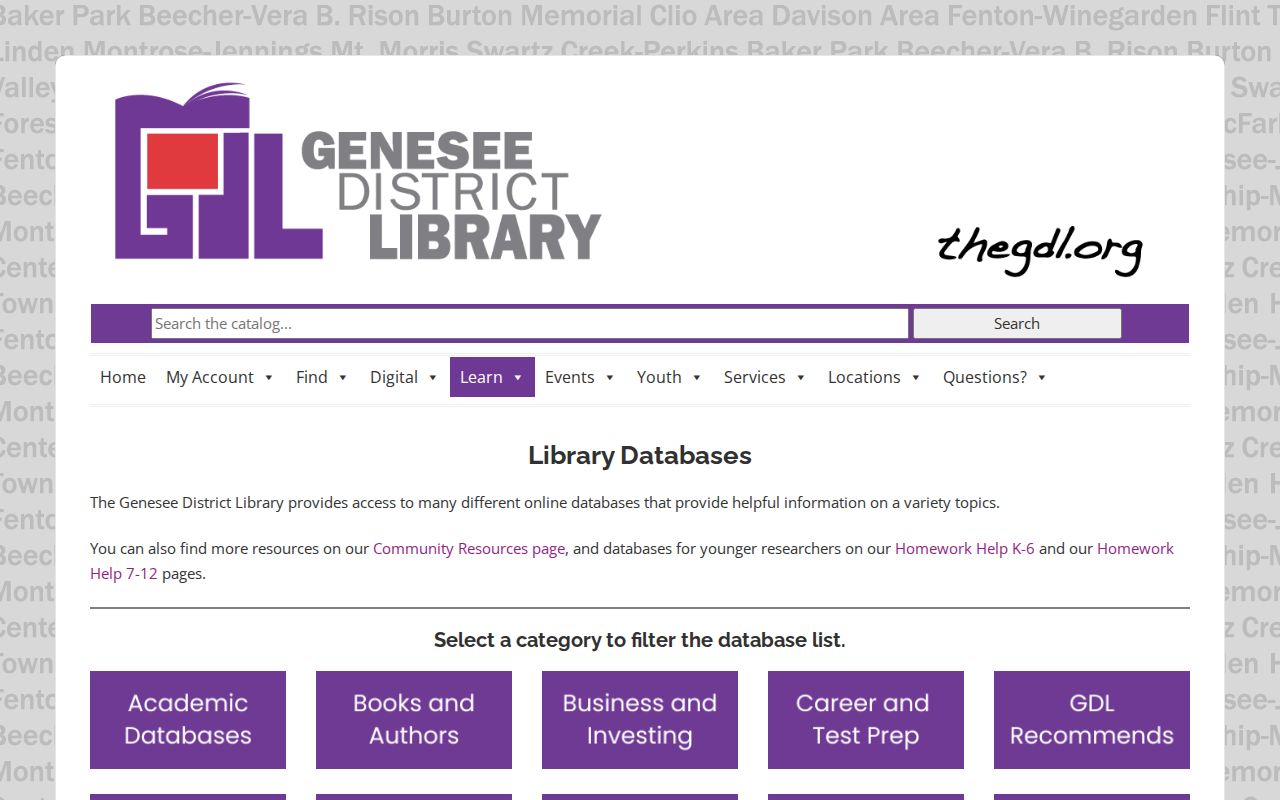
A search-result snippet is only a lead. Save the full article's publication, issue date, page, and archive citation, then compare it with the directory edition rather than treating either source as complete by itself.
Trace Families Through Burton Listings
Begin with the earliest confirmed directory observation, then move forward one available edition at a time. Street listings are alphabetized by street and then house number when an edition includes them, which makes an address useful after a surname search produces several candidates. Pairing the directory sequence with federal census releases helps fill the long gaps between census years. The census is geographic and dated too, so retain the township or city label rather than projecting modern Burton boundaries backward.
- Find a first appearance by surname, preserving the edition, printed name form, and community label.
- Check the next available editions for address changes, alternate initials, or a household-head-only format.
- Use the street arrangement when present to test whether the same address appears under a changed name.
- Pair the dated listings with an available census schedule, newspaper item, parcel record, or deed reference.
- End the trail with a cited obituary, cemetery reading, or another directory rather than guessing why a name disappeared.
For a current address-based record trail, the Burton street directory is the better route after the historical identification is in hand. A directory disappearance can mean a move, a changed format, a skipped issue, an unlisted household member, or a changed geography. It does not identify a cause without another record.
Burton Directory Dates and Labels
Directory chronology needs two kinds of dates: the edition date and Burton's jurisdiction date. Flint-area Polk coverage is described from the 1890s onward, Bresser has a late-1960s role, and NARA identifies Flint directories for 1929 through 1932. The research did not verify a first standalone Burton directory or a final printed Burton-only edition. Treat the volume's title page and coverage statement as the authority for that volume.
- 1856-1920: selected Burton Township assessment-roll years survive at the Archives of Michigan.
- 1859-1898: township elector registers and poll books preserve separate election-era name trails.
- 1890s onward: FPL describes Flint and surrounding-community Polk directories, subject to edition gaps.
- April 6, 1972: Burton's financial statement gives this incorporation date.
- July 1, 1972: city-history material uses this date for the effective municipal transition.
Those 1972 dates are not a conflict to erase. They mark incorporation and a reported effective transition, while older records may still use Burton Township or a nearby Flint label.
Township Records Before Burton Cityhood
Burton's most useful directory story starts before it was a city. Genesee County was organized in 1836, and Burton's surviving trail passes through a township period before municipal incorporation in 1972. The Archives of Michigan identifies township assessment rolls for 1856-1876 and selected later years, poll books for 1880-1898, and registers of electors for 1859-1881. These are record series with their own search keys, not early editions of a modern address book.
A nineteenth-century name may be tied to a township, precinct, section, lot, landowner, or road rather than a current street number. Requesting help with the record group, series, date, and the exact research question gives the Archives of Michigan a usable starting point. The Archives guide also lists naturalization, military, court, cemetery, and census leads that can help test an identification.
1889 Atlas Clues for Burton
The digitized 1889 E. R. Cookingham Genesee County atlas is a useful visual bridge from a modern parcel question to a township plat and a named historical landowner. Its 86 images include township, city, and village plats and directories. Read the atlas beside later assessor maps, deeds, plats, and dated directories. A name on its page is a historical landowner label for the map year, not a current identity or a complete list of people at a place.
The atlas is especially helpful where an older deed uses a legal description instead of a present-day number. Connect the lot, block, section, or metes-and-bounds description through later plats and county instruments before assigning it to an address. Burton research also has to account for its edges with Flint, Genesee Township, Davison Township, Grand Blanc Township, and Flint Township.
A Focused FPL Research Hour
FPL offers an obituary and research-request service for researchers who cannot visit. The recorded charge is $25 up front for about one hour, whether or not the search succeeds. That makes a narrow request important: give the staff a person or address, a date range, name variants, and one specific question. A broad request can use the hour without resolving which person or property is involved.
For a newspaper item, cite the publication, issue date, page or stable item identifier, and whether the result is an index or the full article. Obituaries may supply relatives, former names, organizations, and a last-known location, but they are authored notices and should be compared with a vital record, directory, or family-created notice when the identity matters.
Limits of Burton Directory Evidence
Directories are dated, selective publications. A name can be misspelled, a household can be represented by one person, a street may sit under Flint or another surrounding geography, and phone or classified sections may not exist in the edition being used. Historic coverage is also uneven: FPL describes surrounding-community material, its Sanborn coverage does not include every area, and no authoritative Burton-specific historical-society directory was verified in the research.
Keep a source note with the exact text, date, arrangement, location label, and cross-check. When the question shifts to a present parcel or a recorded instrument, use the Burton Assessor, county parcel tools, or Genesee County Register of Deeds instead of stretching a historical listing beyond its date. Personal research should remain lawful and should never be used to harass another person.
Note: An absent directory entry is a coverage question first, not proof that a person or address did not exist.