
Map Burton Previous Residents by Era
Start the backward trail with the source closest to the date in question. Current parcel information provides the address and legal description. The deed index connects recorded transfers. Dated city directories can name a person at an address, while census and township series place a household in an earlier geography. These sources overlap but do not mean the same thing. A recorded owner is not automatically an occupant, and an address in a directory is a dated printed observation, not a timeless fact.
| Source | Years It Covers | Where Held | What It Shows |
|---|---|---|---|
| Burton Township assessment rolls | 1856-1876; 1884, 1900, 1920 | Archives of Michigan | Historical parcel and tax assessment names and values |
| Burton Township register of electors | 1859-1881 | Archives of Michigan | Historical registered names and election jurisdiction |
| Burton Township poll books | 1880-1898 | Archives of Michigan | Official poll-record observations |
| Genesee deed images and index | Online notice does not reach before 1983; digitization material states 1970-present public access | Genesee Register of Deeds | Title instruments and legal descriptions |
| Flint-area city directories | 1890s-present described; annual coverage varies | FPL and Library of Michigan | Dated address-to-name entries, subject to publisher coverage |
| Federal census | Released under the 72-year rule | NARA and library databases | Dated household and geography context |
For a recent Burton address, begin with the Assessor and the Register of Deeds. For a township-era question, begin with the Archives finding aid and the atlas rather than forcing an old observation into the modern city boundary. The gap between a 1970 digitization statement and the online deed page's pre-1983 limit is real. Keep both dates in notes because public images, searchable indexes, and online availability are not identical.
Anchor a Burton Address Today
The Burton Assessor property-information route supplies the current anchor for a house-history search. Its BS&A link leads to the public property path, and the city says the information is updated daily. The Assessor maintains a record card for each parcel and describes ownership, sales information, and property characteristics as part of that card. Copy the parcel or tax-map identifier, situs address, owner or taxpayer label, legal description, roll year, and source date before looking for older household entries.
The assessor also distinguishes a parcel location from a mailing address. The situs is where the parcel sits. The mailing address is where tax correspondence is sent. A different mailing address can be a useful lead, but it does not prove physical residence. Genesee Parcel History can add owner, address, tax-map, and deed-reference detail, while FetchGIS can confirm the parcel geometry and road context. These checks keep the rest of the Burton address trail attached to the correct land unit.
Note: Preserve the legal description exactly when it appears because it can outlast a road-name or street-number change.
Trace Burton Previous Owners
Past owners are often the first documented layer behind an older household. The Genesee Register of Deeds records deeds, mortgages, liens, assignments, and discharges. Begin with a current parcel and the most recent recorded transfer. Then follow the seller backward as a buyer in an earlier conveyance. The resulting chain of title is evidence of recorded land transfers, not proof that every owner lived at the property.
- Copy the current parcel, situs address, legal description, and owner or taxpayer label from the Burton assessor record.
- Find the current owner's purchase as a grantee in the Register of Deeds index. Record the grantor, instrument type, recording date, document number or Liber/Page, and legal-description text.
- Search that seller as a grantee to locate the earlier acquisition, then compare the legal description before moving one step farther back.
- Repeat the grantor-to-earlier-grantee pattern, keeping mortgages, assignments, liens, and discharges distinct from deeds.
- When the trail reaches the online boundary, use the historical index books, office copies, or the appropriate archive route. Confirm an index lead against an image or a copy when instrument wording matters.
- Grantor
- The person or entity transferring an interest in a recorded instrument.
- Grantee
- The person or entity receiving an interest in that instrument.
- Chain of title
- The sequence of recorded transfers and related instruments connected to a parcel.
- Legal description
- The lot, block, subdivision, section, or metes-and-bounds description used to identify land in formal records.
Use Genesee Historical Indexes
Older Burton transfers require the county's Historical Index Book method. Select Deed Index Book or Mortgage Index Book, choose the year and first letter of the person or business, and use the Document Type prefix to narrow the book. DE indicates a deed with grantor and grantee; DEGR is grantor only; DEGE is grantee only; MTG is mortgage with grantor and grantee. One book is used for each document, and the guide provides image, next-page, and Go-To page controls.
Write the book type, year, party initial, prefix, page number, image reference, spelling variant, and Liber/Page into the house-history record. The county notes that its online records before 1983 are not accessible online. It also states that 1736-1772 book images exist without an index. Those images predate Burton's city identity, yet they demonstrate a key address-history rule: no name-index hit is not the same as no land record.
Note: An index-book entry identifies a research lead, while the document image or office copy supplies the instrument language.
Find Burton Previous Residents in Directories
Flint Public Library's House History service recommends R.L. Polk and Company directories for Flint and surrounding communities from the 1890s to the present. Its sequence also includes street and plat maps, county histories, assessor and treasurer records, deeds, newspaper clippings, census sources, and the Historic Homes Binder. The library cautions that directory coverage is not universal and that the binder has notes for only a small number of properties. Treat a directory listing as one dated entry in the story of who lived here before.
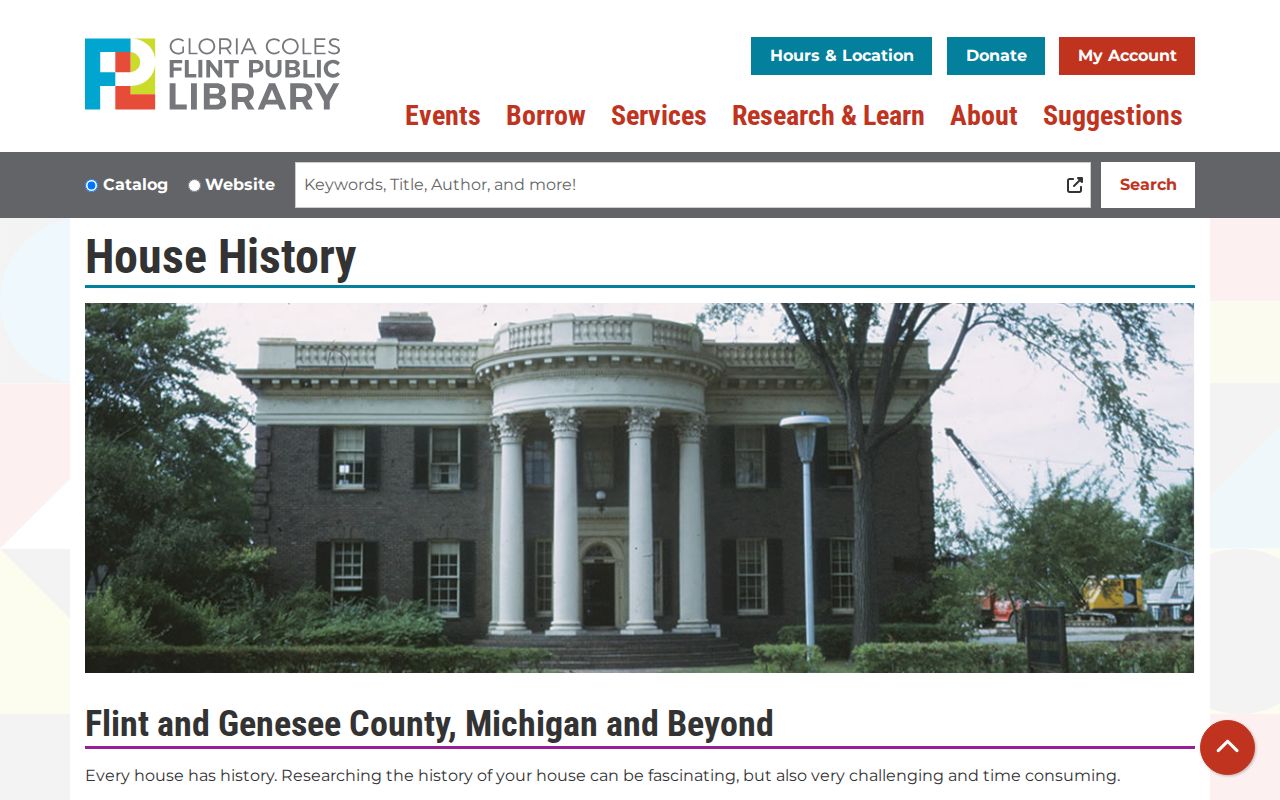
The library image points to the practical house-history route: use the directory's street arrangement and house number, then record the edition, page, city or community label, and the exact address form. The result can help locate past residents, but it should be compared with a parcel, deed, census, or newspaper source before an identity is treated as established. The historical volumes are cataloged more fully through the Burton city directory collection route.
For a focused remote question, the library says its staff research service costs $25 upfront for about one hour whether or not the search succeeds. Give staff the address, date range, name spelling, and source sought. That is a service fee, not a promise that a directory or obituary entry will be found.
Pair Burton Directories and Census
A directory and census schedule serve different purposes. City directories can fill intervals between census years and may be arranged by surname, street, phone, or classification. The Library of Michigan says entries can include household members, an exact address, ownership or occupancy marks, and other source-specific information. A directory may list only a head of household. Census geography also may not match current Burton boundaries, especially for township-era material.
- Choose a directory year and record the address, printed name, publisher, page, and geography label.
- Check the nearest publicly released federal census year, noting township, city, ward, or enumeration geography as printed.
- Compare names, ages, relationships, and location with the parcel or deed trail without assuming a shared surname proves a household.
- Fill gaps with the next directory edition, newspaper notice, obituary, or map source, and label every observation by date.
The federal 72-year release rule makes the 1950 census available, while later schedules remain unavailable until their applicable release dates. For older Burton entries, use the source's township or city wording. A directory marked Flint may be a valuable nearby lead but not a complete Burton roll.
Note: A blank year is an information gap, not evidence that an address had no owner, occupant, or directory entry.
Search Burton Township Records
Burton's past extends through a township period before city incorporation in 1972. The Archives of Michigan Genesee County guide identifies Burton Township assessment rolls for 1856-1876 and selected later years, a register of electors for 1859-1881, and poll books for 1880-1898. These series use township, year, name, precinct, or record-group clues rather than a modern address field. They can place a person or property in the historical administrative setting, but they should not be recast as a modern street listing.

The Archives route is most useful when a deed or directory trail reaches a township-era name, legal description, or landowner. Send the record-group and series reference with a narrow date, person, road, or parcel question. The guide lists its Archives contact at 702 W Kalamazoo Street in Lansing, but requests should use the current repository instructions. That focused approach is better than requesting every Genesee record at once.
Note: Preserve the Burton Township label because it identifies the historical jurisdiction rather than a present-day city street assignment.
Map Burton From 1889
The 1889 Genesee County atlas offers a Burton Township story layer that a deed index cannot supply on its own. Its 86 digitized images include township, city, and village plats, road context, directories, and landowner labels. Start from a current road or parcel, identify the relevant historical plat, then work forward through later plats and recorded instruments. Cite the specific map image and year whenever a historical landowner is used.
A legal description can remain useful after a street number or road label changes. That makes the atlas a bridge, not proof of a one-to-one modern address match. Burton directly adjoins Flint and meets Genesee, Davison, Grand Blanc, and Flint townships, so a record's location label must remain attached to the evidence. This prevents a historic Burton Township clue from being mistaken for a current city location.
Read Genesee Records by Numbers
Genesee records-management material describes about 85,000 Register of Deeds documents a year and more than 35,000 certified vital copies. The quantity is a reason to make a compact research log for each Burton address: source title, date, exact address, jurisdiction, parcel or tax map, named person and role, page or record number, source URL, and confidence. Add an unresolved field for number changes, missing years, or conflicts.
The same material identifies Tyler Eagle installation in 2018 and Vital Records software in 2020, with documents from 1970 to the present digitized or available for public access. A single scanned album may still lack an index. A failed search should prompt a check of the image, book, office, library, or archive route rather than a statement that a prior household did not exist.
Note: Record digitization and searchable-name coverage as separate facts when a Burton document cannot be found through the public interface.
Limit Burton Previous Resident Claims
Address-history research has firm limits. A current owner or taxpayer is not automatically a person who lived at the address. A directory may omit people, cover only part of the area, or use a Flint label. An obituary is authored notice evidence and should be checked against another source when identity matters. Census geography can differ from the current city line. Michigan's Address Confidentiality Program also protects enrolled voter information from the ordinary voter-record process.
Lawful use. Burton house-history research supports family history, personal curiosity, civic context, and property history. Do not use results to stalk, harass, intimidate, or harm anyone.
Use the most modest conclusion supported by the records. A dated title transfer can show a past owner. A dated directory entry can show a name printed at an address. A well-cited chain can show how those observations may connect. When the record does not support the connection, retain the gap and ask the identified custodian, library, or archive for the next bounded source.